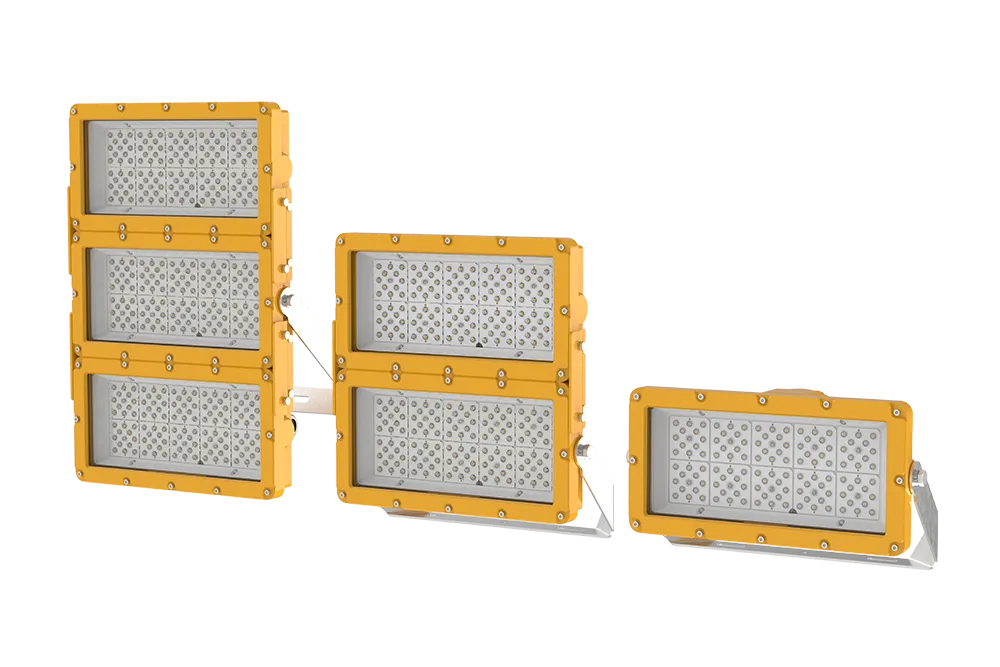
Opening our article reviews all techniques with fire-resistant fixtures within processing settings.
Executing securely amid risky locations such as processing plants involves customized equipment aiming to eliminate expected events. Blast-resistant lights are essential elements in equivalent settings, developed to tolerate ignitable bursts, volatile effluents, and combustible locations. Such machines are not intrinsically non-hazardous; rather they are fabricated to contain any inner energy release or flash and restrict it from triggering a amplified ignition in the adjacent setting. This exposition presents essential instruction about explosion-proof illumination, their employments, and mitigation aspects for deploying them effectively.
Understanding Explosion Proof Lighting Standards
Handling particular hazloc lighting standards can be difficult, especially across operations dealing with hazardous locations. These standards – often referencing authorized bodies like the National Electrical Association (NEC), ATEX (Europe), and IEC – define clear design and construction guidelines to minimize the possibility of combustion from energized machinery. Understanding stipulated standards is important for ensuring worker safety and compliance with regulatory duties.
Luminescent Flame Proof Light Sources: Capability & Precaution
Photon Emission hazloc lighting modules represent a significant development over previously used incandescent equipment in areas where volatile materials are found. These reliable systems also provide high-quality power savings, leading to reduced expenses, but crucially support a boosted grade of safeguarding by reducing the potential of sparks due to energy flare-ups}.
Explosion Resistant Combustible Area Perilous Proof Combustion Flare Flare Resistant} Fixtures : A Complete Synopsis
Explosion Hardened Flammable Site Critical Proof} Devices are particularly engineered lighting techniques built to execute safely within capably explosive sites. These tough fixtures eliminate sparks, thermal output and voltage sparks from igniting a significant explosion. They usually incorporate tailored designs, involving for example impermeable housings and naturally safe power items to provide safety codes in markets like oil & flammable gas processing, manufacturing plants, earthworks operations, and medication production.
Appointing the Appropriate Detonation-Safe Luminaires for Critical Zones
Recognizing the optimal hazloc luminaries for a selected at-risk location obliges detailed inspection. Elements such as the rating (e.g., Class I, II, or III and sections 0) should be exactly verified to confirm agreement with relevant protection rules. More than the zone's inherent hazards, evaluate ecological factors, encompassing degrees and humidity, to identify a strong and stable solution. Regularly collaborate with a authorized specialist to help your evaluation.
Settings Where Are Explosion Proof Lights?
Explosion-proof also known as intrinsically safe|hazardous location|Class-rated} lighting fixtures are undeniably needed in diverse areas where flammable vapors or powders could possibly create a perilous atmosphere. This frequently includes production conversion plants, blemish treatments application areas, grain handling facilities, and sewage treatment locations. Regulations, such as those from OSHA and NEC, mandate their deployment in these regions to lessen the risk of flames and protect security functionality.
Pros of Crystal-Based in Detonation Safe Systems
Embracing Crystal-Based technology for detonation-safe systems offers a important collection of pros. First, photon emitters boast a markedly longer service life compared to traditional vapor lights, reducing maintenance disbursements and cessations. They are also primarily safer, producing lowered temperature which lessens the chance of flare-ups in flammable atmospheres. Also, luminescent sources are considerably energy efficient, leading to declined voltage use charges and a reduced sustainable environmental cost. Finally, the sturdy construction of Semiconductor appliances tolerates the harsh milieus typical of fire-safe areas.
- Increased Longevity
- Diminished Servicing Disbursements
- Boosted Security
- Curtailed Voltage Consumption
- Strengthened Robustness
Managing and Assessing Explosion Proof Lighting Systems
Regular care and detailed scrutiny of ignition-resistant lighting frameworks are essentially indispensable for upholding safety and minimizing potential hazards. This entails a periodic review of all modules, such as luminaires, ducts, wiring, and related junction boxes. Especially, test for degradation, structural faults, and adequate earthing wire. Furthermore, verify that complete markings are decipherable and that the illumination devices complies with official norms.
- Undertake observable reviews.
- Assess circuit integrity.
- Substantiate intrinsically safe properties.
Forthcoming of Explosion Proof Lighting Technology
Growing landscape of explosion-proof appliances technology offers a notable shift from traditional designs. Future technologies will more and more incorporate explosion proof lamps remote capabilities, enabling wide-area monitoring, diagnostics, and dynamic control. We foresee a increasing adoption of electroluminescent technology, not only for its basic energy efficiency, but also its competence to facilitate mounted sensors for detecting hazardous conditions. Moreover, materials investigation is pushing innovations in hardy shell materials, allowing for slimmer and enhanced designs, while sustaining the needed levels of defense.
- Boosted battery life for movable applications.
- Unification with anticipative maintenance bases.
- Construction of hands-free lens techniques.